
Hardscapes in Mount Pleasant & Charleston
Paver patios, flagstone and gravel walkways, and retaining walls, built on a base that's dug out and compacted before anything goes on top.
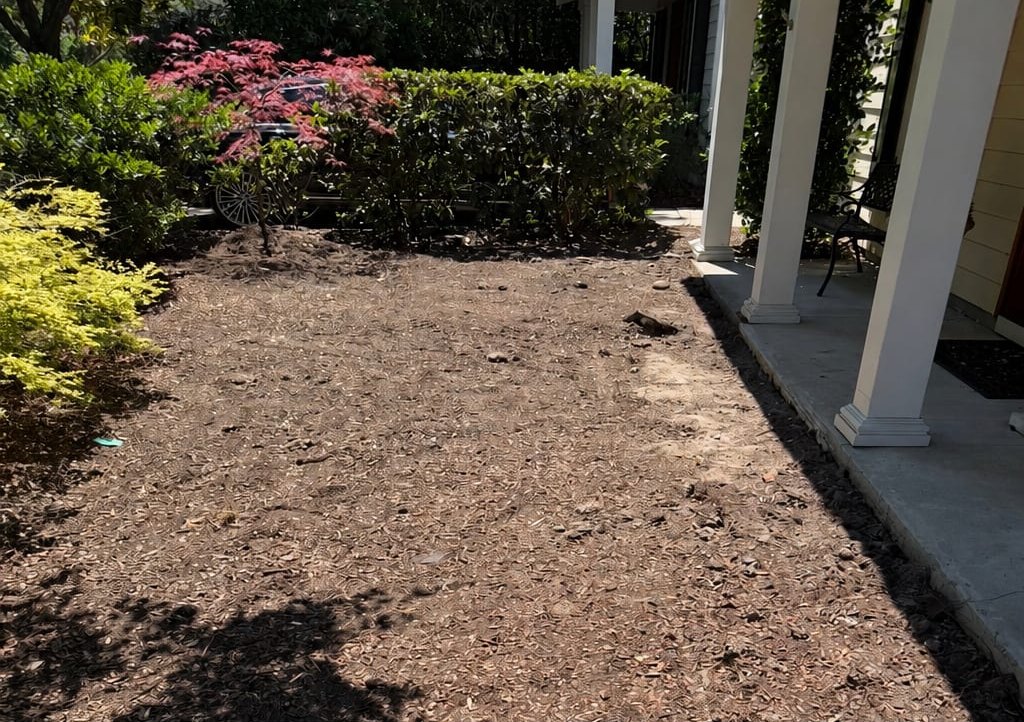
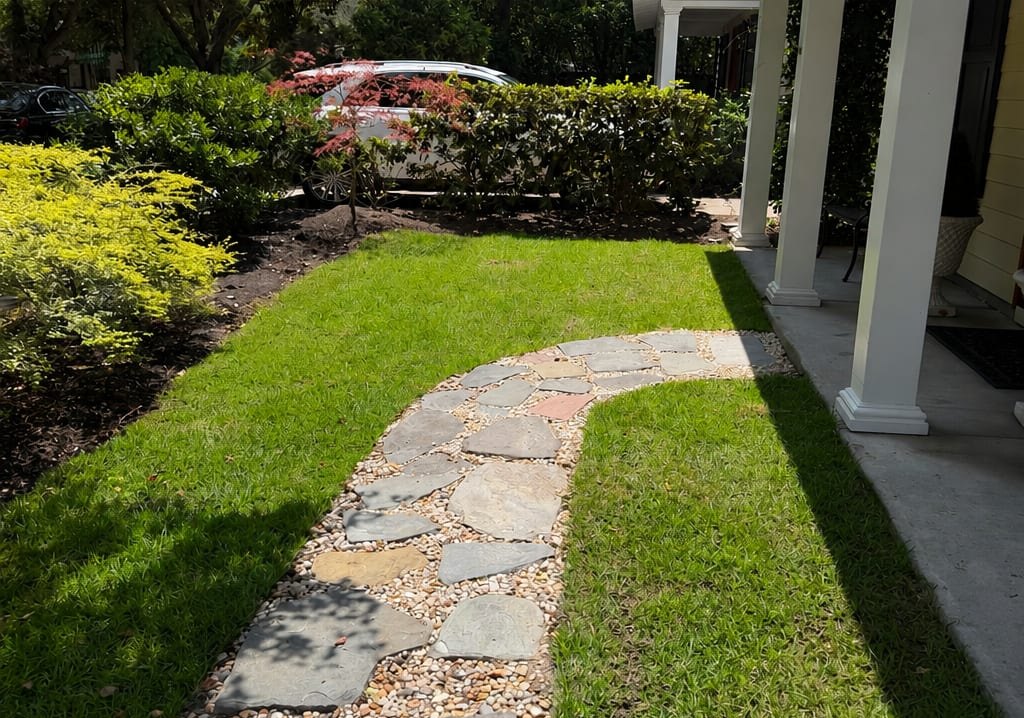
A patio is only as good as what's under it. When pavers sink, the cause is usually underneath. The base was too thin or never compacted, or it went down over roots that rotted and settled.
What’s included
- Paver patiosLaid on a dug-out, compacted stone base, with an edge that holds them in place
- Walkways & pathsPavers, flagstone or gravel, from the drive to the door or across the yard
- Retaining wallsBlock walls with gravel and a drain behind them, for slopes and raised beds
- Fire-pit areasA level, compacted pad with room to sit around it
- StepsSet into a slope, or up to a patio or porch
- Gravel patiosA compacted base and a firm edge, so the stone stays where it's put
- Base & excavationThe digging, grading and compaction under all of it
Pavers, stone, or gravel
Pavers
Concrete pavers on a compacted stone base and a thin bed of sand, locked in by an edge restraint. The surface can flex a little without cracking, and a section that settles can be lifted and reset.
Best forPatios and walkways you use every day
Flagstone
Natural stone, set dry in gravel or sand, or mortared onto a concrete slab. Set dry, it drains and can be re-leveled. Mortared, it's firmer underfoot, but only as sound as the slab under it.
Best forWalkways and garden paths with a natural look
Gravel
A compacted base with gravel on top and a firm edge to hold it. The simplest of the three and the easiest to change later, though it shifts underfoot and needs topping up.
Best forSide yards, paths and fire-pit areas
Questions people ask
Including the local rules. Where a town has the final word, we say which one and how to reach it.
How much does a paver patio cost?
There's no price list here, on purpose: no two pieces of ground are the same. Josiah walks it and gives you a straight number. What it comes down to:
- Size and shape. The square footage, and how many curves and cuts it takes. Straight edges go faster than curves.
- The material. Pavers, natural stone or gravel, and the pattern they're laid in.
- What's underneath. How much soil comes out, how much stone base goes in, and whether wet ground calls for a thicker base.
- What's there now. An old patio, roots or a stump in the footprint, all taken out before the base goes in.
- Walls and steps. How long and how tall. A taller wall needs an engineered design.
- Access. Getting a machine, stone and pavers to the back yard.
What goes into a paver patio that won't sink?
Not a problem so much as a project. The part most people underestimate is underneath it: a patio on a base that wasn't dug out and compacted properly starts to move.
Digging out the footprint, clearing roots and soft soil, and building a compacted stone base in layers, sloped so water runs off. Then the pavers, stone or gravel on top, with an edge that holds them. The dirt work is most of the job, which is why we do both.
Why are my pavers sinking, and can they be fixed?
Usually what's under them: a base that was too thin or never compacted, roots or soft soil left underneath to rot and settle, no edge holding the pavers in, or water running under the patio instead of off it.
Most can be. The pavers come up, the base under the low area is dug out and rebuilt in compacted layers, and the pavers go back down. Where the edge is the problem, a proper edge restraint goes in.
How do you stop a slope from washing out?
Bare soil on a grade, with water running down it every time it rains. Sometimes a downspout or a neighbor's runoff is aimed straight at it.
On a gentle slope, planting and pine straw, which holds on a slope better than most mulches. Where it's too steep for that, a retaining wall with gravel and a drain behind it, and an engineered design if the wall has to hold back more than 4 feet of earth.
How deep should the base be under a paver patio?
At least 4 inches of compacted stone base under a patio or walkway on well-drained soil, and 6 under a residential driveway, by the construction guide of the Concrete Masonry & Hardscapes Association (CMHA Tech Note PAV-TEC-002). Ground that stays wet or soft needs more. The base goes down in compacted layers with about an inch of bedding sand on top, and that sand is never used to make up for an uneven base.
Do I need an engineer for a retaining wall?
Past a certain height, yes. The residential building code requires an engineered design for a wall that holds back more than 48 inches of earth (the difference in ground level from one side to the other) without support at the top, or for one over 24 inches that also carries loads besides the soil behind it, such as a driveway above it (IRC R404.4). A town or an HOA can add rules of its own.
Why do retaining walls lean or fail?
Often, water. The industry's best-practices guide for block retaining walls (CMHA) calls poor water management a frequent source of problems in any retaining wall: water trapped behind a wall adds pressure it wasn't designed to take. So a block wall gets at least 12 inches of gravel behind it, a drain pipe at the base to carry the water out, and a first course set below grade on a compacted pad.
Do I need a permit for a patio in Mount Pleasant?
It can. The Town requires its stormwater management and tree preservation permit before land on a single-family lot is graded or otherwise disturbed, applied for along with a building permit. The Town counts a patio as impervious ground cover, and in the Old Village an overlay district caps impervious surface at 40 percent of the lot. The Town's Engineering and Environmental Division takes questions at (843) 884-8517.
Can a patio go under a big oak?
Carefully, and not always. Digging and compacting a base is exactly what hurts trees: Clemson Extension names soil compaction, grade changes and cut roots as the three main causes of tree death during construction, and advises keeping equipment out beyond the drip line. Near a tree worth keeping, the patio's footprint and base get planned around the roots, and an arborist's opinion is worth having first.
Let's talk about your next project
Tell us what you're dealing with
Free on-site quotes across Mount Pleasant and the greater Charleston area.
ServingMount Pleasant · Isle of Palms · Sullivan's Island · Daniel Island · Charleston · West Ashley · James Island · Johns Island · Folly Beach