Full clear
Everything comes out: brush, trees and stumps, down to bare, workable ground.
Best forHouse pads, pools, driveways
Service 01
Overgrown lots, underbrush and small trees cleared down to usable ground, with the trees worth keeping left standing and the debris hauled off.
The work
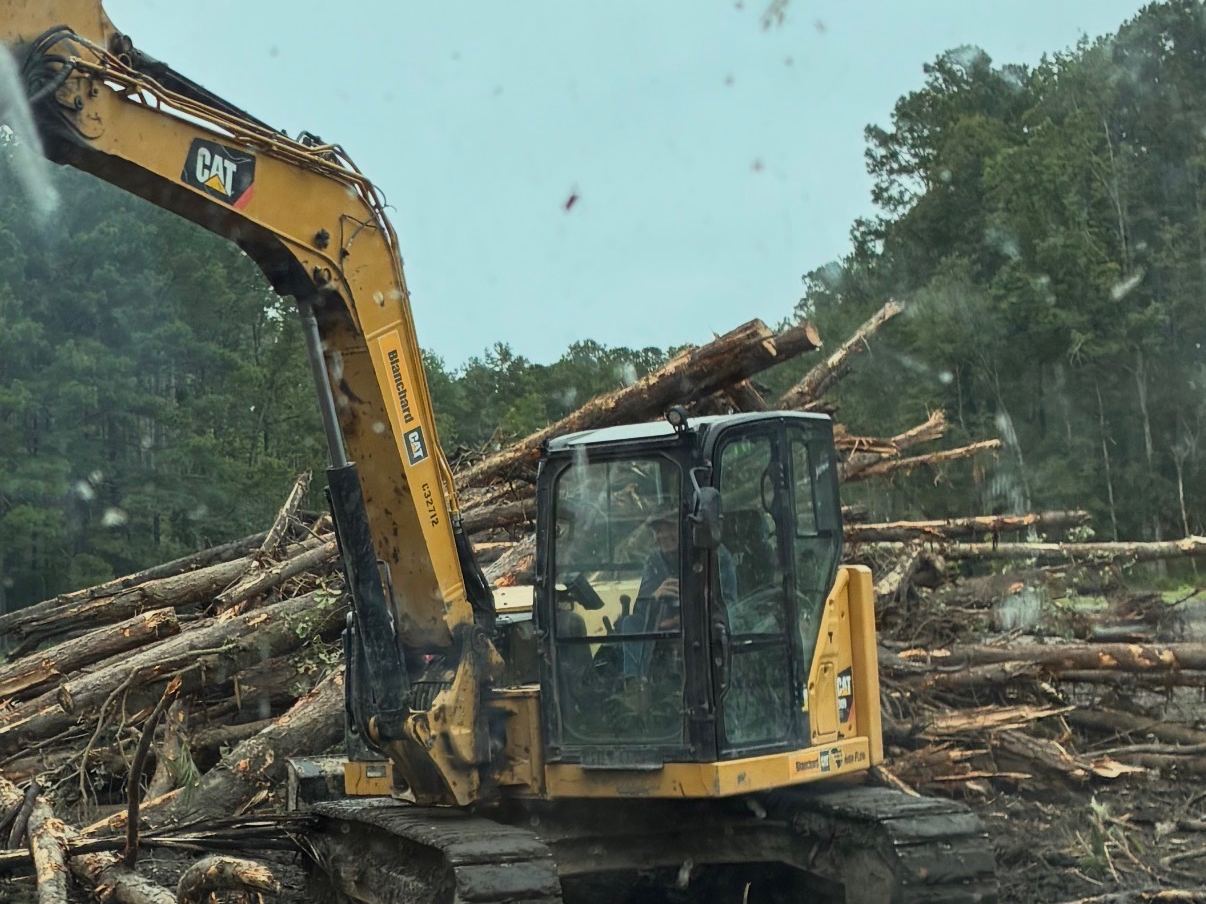
Most clearing in the Lowcountry isn't about flattening everything. It's about getting back ground the undergrowth took: a back acre gone to vines and sweetgum, a lot that has to open up before a build, a fence line nobody can walk anymore.
Know your options
Everything comes out: brush, trees and stumps, down to bare, workable ground.
Best forHouse pads, pools, driveways
The brush and scrub trees come out. The trees you pick stay, and the machine works around their roots rather than over them.
Best forWooded lots you want to live on
Only the understory goes: vines, briars and saplings. The canopy overhead is left alone.
Best forReclaiming a back acre, trails, fence lines
Straight answers
Including the local rules. Where a town has the final word, we say which one and how to reach it.
There's no price list here, on purpose: no two pieces of ground are the same. Josiah walks it and gives you a straight number. What it comes down to:
Lowcountry undergrowth reclaims unused ground quickly, and once sweetgum, wax myrtle and vines establish in it, clearing by hand stops being realistic.
Clearing the brush, undergrowth and small trees down to usable ground, pulling the stumps that are in the way, and hauling the debris off so you can see what you actually have.
Most wooded Lowcountry lots have good oaks and pines standing in a thicket of vines, sweetgum and scrub. It's the thicket that makes the land feel unusable, not the trees.
Selective clearing: the brush, briars and saplings come out, the trees you choose stay, and the machine works around their root zones instead of driving over them.
Not a problem so much as the first step. The builder needs the footprint, the driveway and a work area opened up, and usually wants the trees outside that left alone.
Clearing the building area, drive and access down to workable ground, pulling stumps wherever something will be built, and hauling the debris off, with the trees outside the clearing line left standing.
Usually, yes. The Town requires a zoning permit before any lot is cleared, excavated or filled (Zoning Code §156.1171), and protected trees need their own removal permit. Unincorporated Charleston County requires a stormwater permit once land disturbance passes 5,000 square feet. Rules differ town by town, so the permit question gets answered before the work is scheduled, not after.
No. Mount Pleasant keeps a natural, undisturbed buffer landward of the state critical line, averaging 35 feet and never less than 20 (Zoning Code §§156.622–156.623), and the City of Charleston does not allow trees in its critical line buffer to be removed. The marsh itself is state critical area, and altering it needs a state permit.
Have it looked at before anything is cleared. Under federal rules, mechanized land clearing in a wetland can count as a regulated discharge (33 CFR 323.2), which needs a permit from the Army Corps of Engineers, Charleston District. The federal definition of a regulated wetland is being rewritten as of 2026, so on low, wet ground a wetland delineation is the safe first step.
Not in town. Mount Pleasant only allows burning inside an approved, screened, non-combustible container (Town Code §92.30), and South Carolina's open-burning rules keep land-clearing fires at least 1,000 feet from homes and public roads. On a residential lot, the debris gets hauled off.
Not if a contractor cut it. Mount Pleasant and the City of Charleston both leave debris from hired work to the contractor to haul away, which is why where the debris goes is part of the quote from the start.
Free On-Site Quotes
Free on-site quotes across Mount Pleasant and the greater Charleston area.
ServingMount Pleasant · Isle of Palms · Sullivan's Island · Daniel Island · Charleston · West Ashley · James Island · Johns Island · Folly Beach